
Gregory D. Hager is the Mandell Bellmore Professor of Computer Science at Johns Hopkins University, and holds joint appointments in the Department of Electrical and Computer Engineering and the Department of Mechanical Engineering. Hager is known for his research on collaborative and vision-based robotics, time-series analysis of image data, and medical applications of image analysis and robotics. He has published more than 300 articles and books on these topics. Hager is the founding director of the Johns Hopkins Malone Center for Engineering in Healthcare, an interdisciplinary research center aimed at developing innovative healthcare technology and systems.

Hager’s many contributions to the field of vision-based robotics has earned him status as an IEEE Fellow. Additionally, he has been named a Fellow of the MICCAI Society, the Association of Computing Machinery (ACM), the American Institute for Medical and Biological Engineering (AIMBE), and the American Association for the Advancement of Science (AAAS).
In 2014, he was awarded a Hans Fischer Fellowship at the Technical University of Munich’s Institute of Advanced Study, where he also holds an appointment in computer science.
Hager also is a co-founder of two startups: Clear Guide Medical, whose groundbreaking platform enables doctors and technicians to perform more accurate ultrasound-guided procedures, and Ready Robotics, dedicated to making industrial robots easier to use.
Hager received his BA in mathematics and computer science (summa cum laude) at Luther College (1983), and his MS (1986) and PhD (1988) from the University of Pennsylvania. He was a Fulbright Fellow at the University of Karlsruhe, and was on the faculty of Yale University prior to joining Johns Hopkins in 1999. He has served as the deputy director of the NSF Engineering Research Center for Surgical Systems and Technology, and as chair of the Department of Computer Science from 2010-2015.
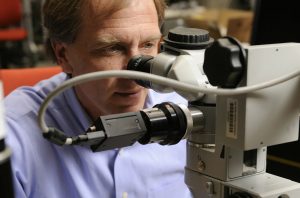 Hager’s lab, the Computational Interaction and Robotics Lab (CIRL), studies problems that involve dynamic, spatial interaction at the intersection of imaging, robotics, and human-computer interaction. As a leader in the development of algorithms for real-time computer vision and their uses for robotics, Hager’s work offers novel applications for automated surgical training, medical imaging and diagnostics, and computer-enhanced interventional medicine. CIRL is associated with the NSF Engineering Research Center for Computer-Integrated Surgical Systems and Technology (ERC-CISST) and the Laboratory for Computational Sensing and Robotics (LCSR).